India is the largest source of international medical graduates (IMGs) in the United States. Over 50,000 Indian-origin physicians are currently licensed to practice in the USA - and that number grows every year. If you have completed your MBBS in India and want to practice medicine in the USA, getting a residency in the USA after MBBS India is the path you need to follow.
Residency programs are postgraduate training programs for Indian MBBS graduates and international medical graduates (IMGs) who have graduated from medical school and earned an M.D. or D.O. degree. Residency programs provide specialised clinical training in areas such as internal medicine, Pediatrics, surgery, and family medicine.
The residency application process for Indian doctors is competitive. Applicants should carefully research the programs they are interested in and submit strong applications. Most residency programs require applicants to submit the following materials:
Some residency programs may also require additional materials, such as research experience or foreign language fluency. Over 13,000 residency programs in the United States are accredited by ACGME. Residency programs vary from three to seven years, depending on the specialty. Some of the best residency programs in the U.S. for medical students include:
Medical Residency in the USA for Indian Doctors and IMGs
IMGs are physicians who have graduated from a medical school other than a U.S. or Canada Med School. IMGs planning to practice medicine in the U.S. should complete a residency program accredited by the Accreditation Council for Graduate Medical Education. To be eligible for a residency program in the US, IMGs must have a valid ECFMG certificate. For Indian doctors, this means your MBBS degree and internship must be verified through ECFMG's medical education credential verification process. The ECFMG certificate is issued by the Educational Commission for Foreign Medical Graduates to IMGs meeting specific educational and clinical requirements.
Apart from this, obtaining US clinical experience for Indian IMG (USCE) and solid letters of recommendation from U. S. doctors markedly enhance an Indian IMG's chance of getting a match.
But here is something most IMGs miss. How you present all of this on your ERAS application for Indian IMG matters just as much. Program coordinators spend less than a minute on each profile. If your ERAS CV for Indian IMG is not structured well, your experience gets overlooked - no matter how good it actually is.
Top Specialties with Highest Salaries after Residency
During residency, pay is standardized. Most residents earn between $60,000 and $70,000 a year, regardless of specialty. That changes significantly once residency is over.
In 2024, seven specialties topped $500,000 in average annual pay. Orthopedics led the list with an average income of $564,000, followed by plastic surgery, radiology, cardiology, and gastroenterology. The table below shows the latest figures, sourced from the 2025 Medscape Physician Compensation Report.
| Specialty |
Avg. Annual Salary (2024) |
| Orthopedic surgery |
$564,000 |
| Plastic surgery |
$516,000 |
| Radiology |
$520,000 |
| Cardiology |
$506,000 |
| Gastroenterology |
$500,000+ |
| Urology |
$500,000+ |
| Anesthesiology |
$500,000+ |
| Neurosurgery |
$500,000+ |
| Otolaryngology |
$461,000 |
| Vascular surgery |
$500,000+ |
Source: Medscape Physician Compensation Report 2025. Figures reflect full-time compensation including incentive bonuses.
These numbers are not guaranteed. Your actual salary after residency will depend on your location, practice setting, and years of experience. But they give you a clear picture of what is possible - and why your choice of specialty matters far beyond the residency years.
U.S. Medical Residency Programs
There are various online forums and databases that can guide prospective residents to discover suitable IMG-friendly residency programs. These sources might reveal details about:
- Program requirements and eligibility criteria
- Previous match trends
- U.S. clinical experience expectations
- Application competitiveness
Nonetheless, candidates should give the highest priority to official program web pages, ERAS postings, and advice from mentors since residency selection is holistic and differs from program to program.
Application Process for Residency in the USA
In 2025, 60.8% of IMGs who were active in the NRMP Match received a residency offer. For Indian doctors specifically, the match rate improves significantly with strong USMLE scores, U.S. clinical experience, and a well-targeted program list. Understanding how to get residency in USA from India starts with knowing exactly what the process involves - and where most applicants lose their chances.
Residency in the USA after the USMLE is competitive, especially for Indian medical graduates (IMGs). However, getting a residency in the USA with the proper preparation and application strategy is possible.
Here are the steps involved in getting a residency in the USA after the USMLE:
The USMLE is a three-step examination that assesses medical students' and graduates' knowledge and skills. USMLE Step 1 and USMLE Step 2 CK score for residency Indian IMG must be passed to be eligible for residency in the USA.
The residency application process has four main steps - applying through ERAS, attending interviews, ranking programs, and matching through the NRMP algorithm.
- Submission of an application via ERAS
- Interviews with particular programs
- Program and applicant rankings
- Using the NRMP algorithm to match
The step most applicants underestimate is choosing which programs to apply to. You only get a limited number of ERAS program signals. Use them on the wrong programs and you lose your best shot. A smart program signalling strategy for Indian IMG list is built around your scores, your background and how IMG-friendly each program is - can be the difference between matching and going unmatched.
How to Match Residency in USA from India 2026
To get residency in USA after MBBS India, you need to complete these five steps:
- Pass USMLE Step 1 and Step 2 CK
- Obtain ECFMG
- Gain U.S. clinical experience
- Apply to residency programs through ERAS
- Match with a residency program
These five steps look simple. They are not. Each one has decisions inside it - deadlines, documents, strategy - that most applicants only find out about after they make a mistake. The ERAS application for Indian IMG process alone has enough moving parts to trip up even well-prepared candidates. Getting guidance through this phase helps you stay on track and avoid errors that are hard to fix later.
Types of Residency Programs
Residency programs in the U.S. can be categorized into the following types:
- Categorical programs(C) train physicians in a single specialty, such as internal medicine, Pediatrics, or family medicine.
- Preliminary residency programs (P) provide broad-based training in medical fundamentals. After completing a primary residency program, physicians can apply to advanced residency programs in their chosen specialty.
- Primary care residency programs(M) train physicians to provide primary care. It is a type of medical care that focuses on providing preventive and routine maintenance to patients of all ages.
- Advanced programs (A)train physicians in a subspecialty, such as cardiology, gastroenterology, or oncology.
- Transitional year programs (TY) provide broad-based training in medicine fundamentals. Applicants to advanced programs often complete a transitional year program first.
- Reserved programs (R)are for physicians who have already completed some graduate medical education.
For most Indian MBBS graduates entering the USA, categorical programs in internal medicine, family medicine, and psychiatry have the highest IMG match rates.
Medical Fellowship in USA
Medical fellowships are subspecialty training programs completed after residency. An Indian IMG can, in some cases, pursue a medical fellowship in the U.S. without USMLE:
- Research fellowships: There are also fellowships that do not necessarily need USMLE but are usually quite competitive and require significant research experience.
- Pre-residency fellowships: These are created to enable IMGs to prepare for the USMLE and the residency match process. They may not require the USMLE, but they are typically only one year long and do not lead to medical licensure.
- Fellowships in select specialities : There are a few chosen specialities, such as radiology, nuclear medicine and radiation oncology, that have different fellowship requirements for IMGs. For example, the American Board of Nuclear Medicine (ABNM) does not require the USMLE for IMGs who have completed an ACGME-accredited residency in nuclear medicine in their home country.
Can Indian doctor do residency in USA without USMLE?
As an Indian IMG looking to pursue a medical fellowship in the USA without USMLE, it is vital that you look into the requirements of the specific fellowship programs that you desire. You can also meet the Educational Commission for Foreign Medical Graduates (ECFMG) to seek more information on the available opportunities.
Here are some additional tips for IMGs who are interested in pursuing a medical fellowship in the U.S. :
- Get involved in research: Research experience is valuable for any medical fellowship applicant. However, it is significant for IMGs to get involved in research projects at your medical school or home country.
- Network with U.S. physicians: They can help you learn more about the fellowship application process and get your foot in the door. Visit medical conferences and get in touch with doctors in your specialty.
- Collaborate with an educational consultant: An educational consultant could assist you in creating a strong application and in going through a complicated matching fellowship.
Length of Medical Residency
U.S. medical residencies typically last 3-7 years, depending on the specialty. The following table shows the length of different medical residencies in the United States:
| NAME OF SPECIALTY |
DURATION OF THE TRAINING |
| Anesthesiology |
3 Years + P.G. year 1 for Preliminary |
| Family Medicine |
3 Years |
| Neurosurgery |
7 Years |
| Obstetrics / Gynaecology |
4 Years |
| Neurology |
3 Years +PG year 1 for Preliminary |
| Ophthalmology |
3 Years +PG year 1 for Preliminary |
| Orthopaedic Surgery |
5 Years ( includes one year for General Surgery) |
| Pathology |
4 Years |
| Paediatrics |
3 Years |
| Dermatology |
3 Years +PG year 1 for Preliminary |
| General Surgery |
5 Years |
| Emergency Medicine |
3-4 Years |
| Internal Medicine |
3 Years |
| Otolaryngology |
5 Years |
| Urology |
5 Years ( includes one year for General Surgery) |
| Radiation Oncology |
4 Years +PG year 1 for Preliminary |
| Radiation Diagnostics |
4 Years +PG year 1 for Preliminary |
| Physical Medicine |
3-4 Years |
| Psychiatry |
4 Years |
| Plastic Surgery |
6 Years |
| Transitional / Preliminary |
1 Year |
NOTE – The residency length mentioned above is the minimum number of years of postgraduate training required to gain eligibility for board certification.
Benefits, After Residency
- Residents typically receive a salary and benefits, such as health insurance and paid time off. They may also be eligible for tuition reimbursement.
- After completing residency, physicians are eligible to become board-certified in their specialty. Board certification is required for many jobs and hospital privileges.
Tips for Applicants
- Start early. The residency application process can be time-consuming, so it is essential to start early. You will need to start doing research on programs and start preparing your application materials in your fourth year of medical school.
- Be tactful on program choice.When deciding on what programs to apply to, consider your interests and capabilities and career objectives.
- Get involved in extracurricular activities. Extracurricular activities can help you demonstrate your leadership skills, commitment to community service, and passion for medicine.
- Try to gain U.S. clinical experience and focus on strong letters of recommendation.
- Write strong personal statements. Your personal statements must be clear and precise and they should show your experience and qualifications.
- Prepare for interviews. Rehearse and respond to typical interview questions and be ready to talk about your interests, skills and career objectives.
Once the interviews are completed, the next thing to do is to create rank order list strategy for Indian IMG for residency. Most people rank programs based on gut feel. That is a mistake. Your ROL strategy should factor in your real match probability, the program's history with IMGs, and your long-term career goals. A well-built rank list puts you in the best position to match where you actually want to go - not just wherever you happen to land.
Why Indian Doctors Choose MOKSH Academy for USA Residency Guidance?
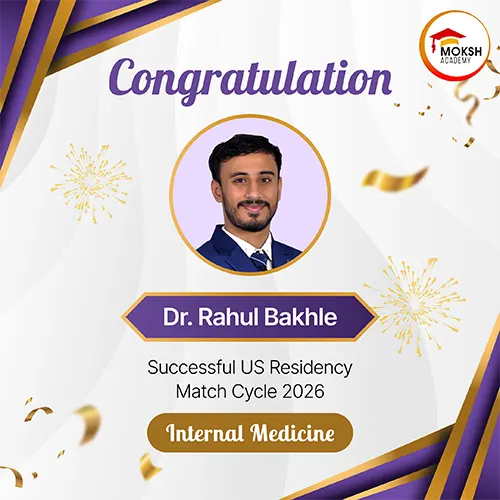
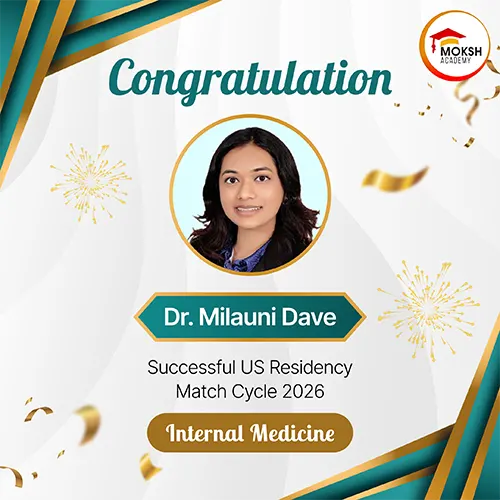
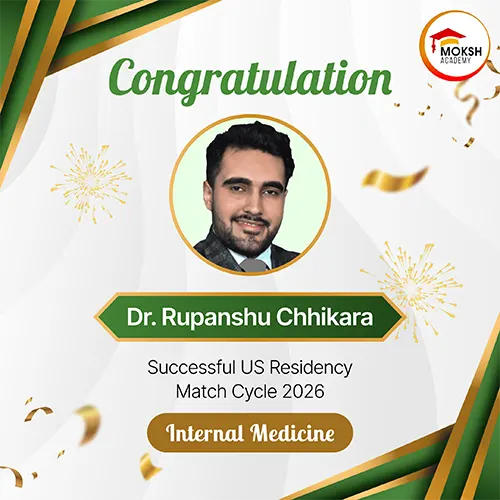
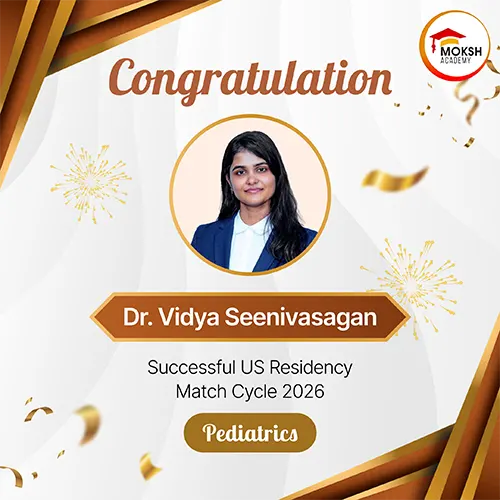
MOKSH Academy has helped Indian doctors from across India - including graduates from AIIMS, JIPMER, KMC, and state medical colleges - successfully match into U.S. residency programs through a structured, step-by-step guidance system.
Going through the U.S. residency process can be very challenging, especially for IMGs who have to manage exams, clinical experience and application strategy. Having a clear plan at every stage will change the story and give you a chance to win.
Residency Match Support (Complete Application Strategy)
The residency application process involves a series of high-stakes processes, such as program choice and final ranking. One of the best ways to get increased odds of a successful match would be to have a well-organised, strategic plan.
MOKSH Academy provides full-service throughout your experience within the Match:
- Program signalling strategy
- A help with program list selection
- Match application guidance
- Interview preparation
- Personal statement revision and advice
- ERAS CV guidance
- Rank order list (ROL) guidance
Why is this important?
The selection of residency for IMGs in the US is quite competitive. There are various factors that play a critical role in making a decision, such as clinical exposure, exam scores, program targeting and performance during the interview.
The structured support from MOKSH Academy enables applicants to:
- Align their profile with the right residency programs
- Strengthen application quality and presentation
- Approach interviews and ranking with greater confidence
Conclusion
Getting a residency in the USA as an Indian doctor is one of the most competitive processes in medicine - but it is achievable with the right guidance at every step. MOKSH Academy has a complete team of experts, and the Mentors play an essential role in making your journey a huge success.
Disclaimer
USMLE® is a joint program. The Federation of State Medical Boards (FSMB) and the National Board of Medical Examiners (NBME) are co-sponsors. None of the trademark holders have affiliation with MOKSH Academy or this website.
ACGME® is a registered trademark of the Accreditation Council for Graduate Medical Education.
The ECFMG® is a registered trademark of the Educational Commission for Foreign Medical Graduates.
The Match® is a registered service mark of the National Resident Matching Program® (NRMP®). The NRMP has no affiliation with MOKSH Academy.
Electronic Residency Application Service (ERAS®) is a program of the Association of American Medical Colleges. It has no affiliation with MOKSH Academy.
Test names and other trademarks are the property of the respective trademark holders. None of the trademark holders have an affiliation with MOKSH Academy or this website.